Travelling At Night Memories, Signs, and Aspects
The currency of growth when there is no XP-from-kills loop
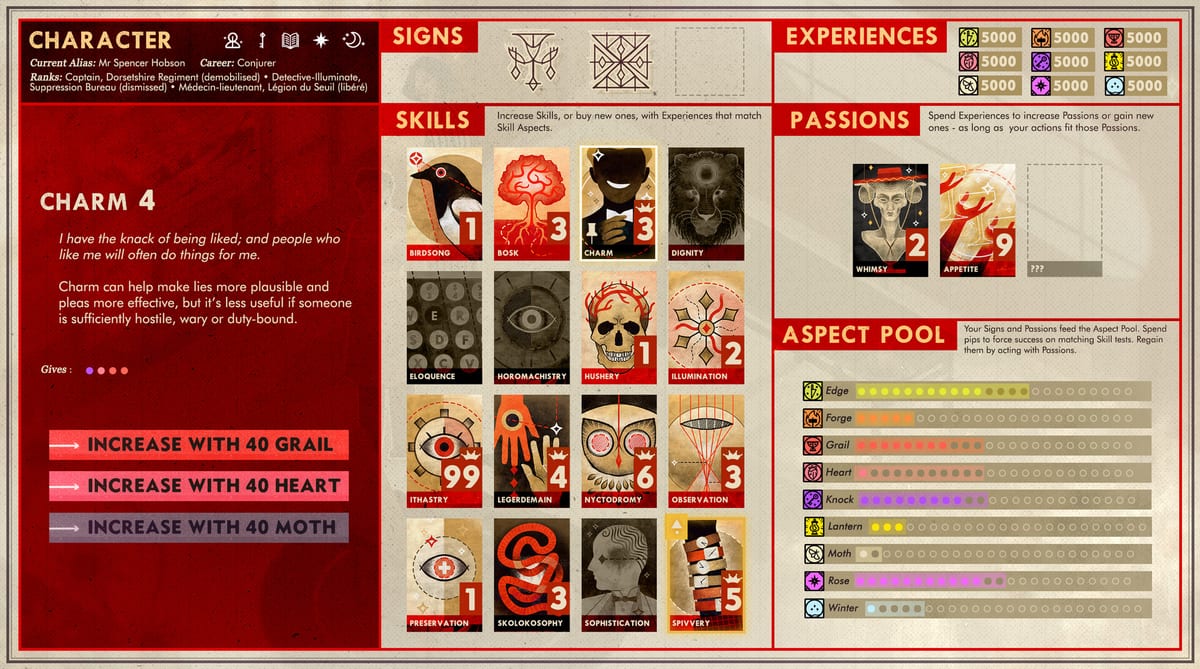
Travelling At Night grows Spencer through Memories, Signs, and Aspects—not loot tables or combat XP. This page explains the progression grammar so Antibes stops feeling like “talk until numbers appear.”
Memories
Memories are fragments gathered from places, people, and inner pressure. Spend them to raise Skills and to feed Passion coherence. Dumping every Memory into one Charm pillar is a classic beginner mistake—see Beginner mistakes. Treat early Memories as thesis funding: two social pillars plus one Career-flavoured skill.
Signs
Signs are readable marks the world leaves—occult, social, institutional. Noticing the right Sign often gates a craft, a dialogue branch, or a Footnote invitation. Careers bias which Signs feel obvious; Exorcists and Conjurers notice different weather than Writers and Physicians.
Aspects
Aspects are the occult/social tags on outfits, places, and sometimes tools. A Respectable Aspect softens institutional Dignity checks; weather Aspects answer Riviera rain. Outfits are Aspect carriers—Outfits. Crafts can produce Aspect-bearing tools—Crafting.
Passions as motive engines
Passions are not dump stats. They colour what Spencer wants from Nenah threads, sanitarium politics, and Footnote choices. Pair Passion pages (Passions) with Memory spends so growth matches motive.
Footnotes as interpretation
When a Memory activates, Footnotes let you interpret History with agency—personality quiz energy borrowed from Book of Hours sensibilities—Footnotes. Skipping them starves flavoured growth.
Checks without combat
Skill checks read your points against difficulty shaped by environment, attitudes, meters, outfits, and companions. Temporary experience spends can save a beat but starve long growth if spammed—How to play.
Demo literacy goals
By Mimata you should be able to explain: where your last three Memories came from, which Sign opened a craft, which Aspect your coat carried into Dr Aubiere’s orbit, and which Passion your Footnotes reinforced. If you cannot, replay one landmark cluster deliberately.
Ties to Dread and Trace
Meters tax the same checks Memories fund. A Memory spend that ignores Dread is half a plan—Dread & Trace.
Planner habit
Log Memory sinks per Career in the Build Planner. Full-game pilgrimage will reuse this grammar across Rosa Mundi routes and colder cities—learn it in Antibes while the map is small.
Memory budgeting example
Session one: bank Dignity and Charm lightly, keep one Memory for a Career craft skill. Session two: fund Passion coherence after a Footnote. Session three: save a temporary spend for a critical institutional check rather than daily spam. Write the budget in the Build Planner.
Sign literacy in Antibes classrooms
Café clusters teach social Signs under Trace pressure. Church thresholds teach craft and sorrow Signs. Bookstore shelves teach Sophistication intel. Sanitarium halls teach institutional Signs that Respectable Aspects answer. Tour classrooms deliberately—Map locations.
Aspects as portable weather
Think of Aspects as portable weather you wear or carry. Rain Aspects answer Riviera gloom; Respectable Aspects answer Incorporate eyes; occult Aspects answer thin-place crafts. When a check fails mysteriously, ask which Aspect was missing before blaming RNG—Outfits, Crafting.
Passions and Memory sinks
A Passion without Memory sinks is cosplay. A Memory sink without Passion is spreadsheet. Align spends so Nenah threads and sanitarium politics feel like the same Spencer—Passions, Find Nenah.
Failure modes unique to this grammar
Over-Charming raises Trace while starving craft gates. Over-crafting without social pillars locks talks. Ignoring Signs makes stations feel “broken.” Skipping Footnotes makes growth flavourless. Each failure mode maps to a beginner mistake—Beginner mistakes.
Full-game transfer
Rosa Mundi routes and dozen-plus cities will reuse Memories, Signs, and Aspects. Antibes is the grammar school. Learn to explain your last three Memories aloud before you board toward Mimata—Complete demo.
Frequently Asked Questions
Quick answers drawn from the demo and official notes.
Are Memories the same as skills?
No. Memories are spendable fragments; skills are the raised capacities.
Do Signs appear as quest markers?
Often as readable world/tooltip cues—not always as loud UI waypoints.
Can outfits change Aspects mid-conversation?
Swap before the scene when possible; treat kits as prep, not panic cosmetics.
Where should newcomers practise?
One café cluster for Trace-aware talk, one church threshold for craft Signs, one Footnote after a Memory.